

Yes, you can make friends online without social media, and the recipe is older than every platform you have an account on: repeated, low-pressure conversation. Social media is built for broadcasting, not befriending, which is why hours of scrolling leave people lonelier than before. Random anonymous chat flips that: every conversation is a real exchange with a real person, and friendships grow out of the ones you keep having. Here is how it works in practice.
Why social media is bad at making friends
Think about what a social feed actually gives you: a stream of other people's highlights, viewed alone. There is no conversation in it, and friendship is basically a long conversation. On top of that, social platforms optimize for the people you already know or the people who look impressive, and meeting someone as a profile first means meeting their highlight reel first. That is a terrible first impression to build a friendship on.
Random chat removes the profile entirely. There is nothing to scroll, nothing to compare yourself to, and no follower count anywhere. What is left is the part that actually creates friendship: talking.
What actually builds friendship
Friendship research keeps landing on the same few ingredients, and none of them are features of a feed:
- Repeated contact. Friendship grows out of interactions that happen more than once, not from one great evening.
- Unstructured time. Side-by-side, no-agenda conversation, the online equivalent of a long walk.
- Gradual self-disclosure. Trading a little personal information back and forth, at a pace both people control.
Anonymous chat is unusually good at the third one. Without profiles and reputation, people open up faster, and the exchange of personal things is exactly the currency friendship runs on. And since all three ingredients grow best one person at a time, it helps that the format itself is built for twos: we compared why private conversations work better than group ones in a separate piece.
The EN-friendly version of the plan
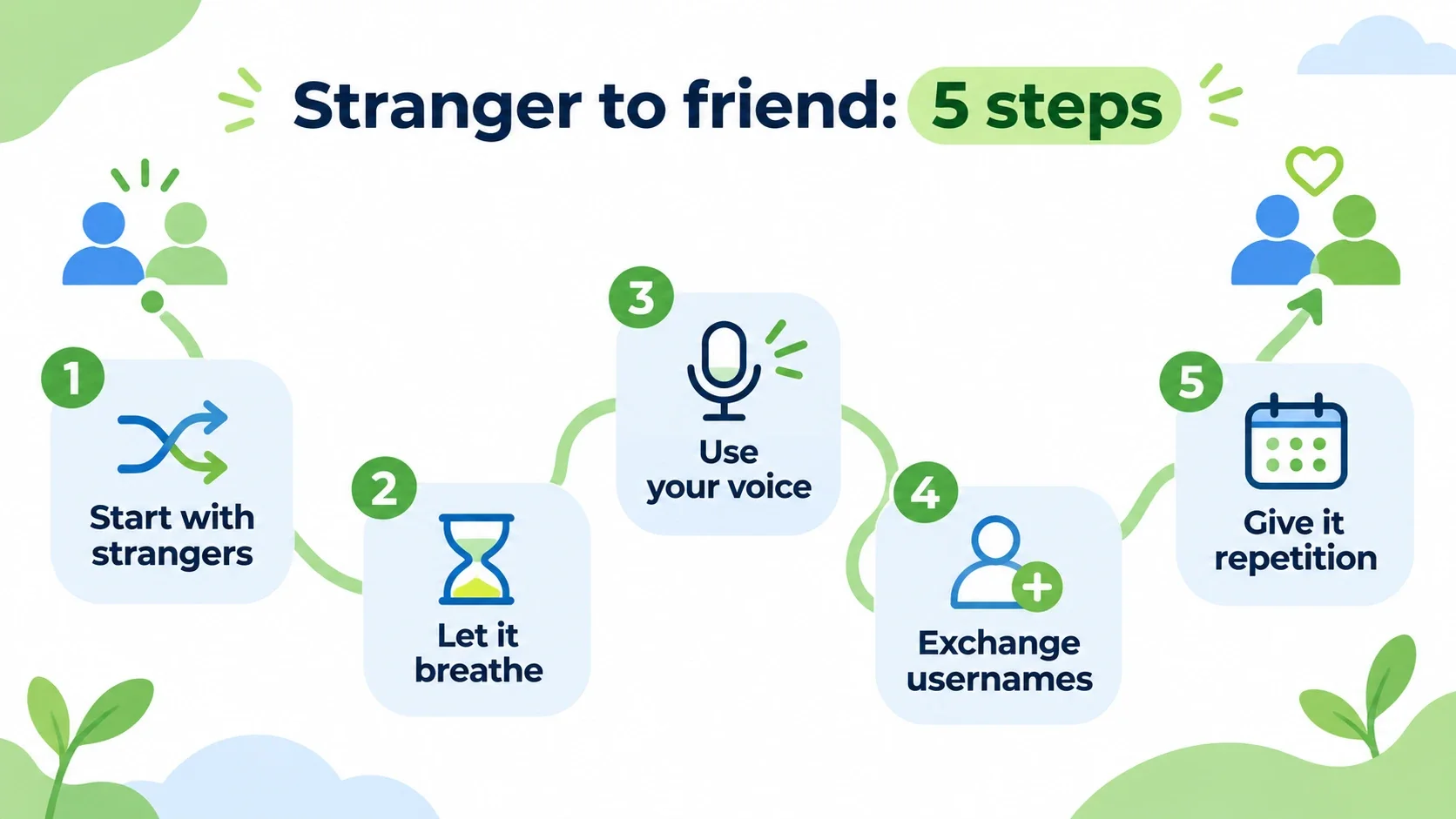
1. Start with strangers, on purpose. The whole point of random chat is that the first message carries zero social risk: nobody knows you, nobody will see your profile afterward. Open Chatus, get matched, talk. Low stakes is the feature, not a bug.
2. Let a good conversation breathe. A friendship rarely starts as a friendship. It starts as a chat about music that accidentally lasts two hours. If you two click, say so: "this was a great talk." Naming it makes the next step natural.
3. Use your voice when it gets real. Voice changes the texture of a conversation, and it is a lot easier to feel like someone is a friend once you have heard them laugh. If typing has taken the chat as far as it goes, suggest voice; when that moment usually arrives is covered in our guide to voice chat timing.
4. Exchange usernames when it clicks. In anonymous chats, trading usernames is the standard way to keep in touch: no algorithm decides whether you ever see each other again, and repeat matches are not guaranteed. Do it while the conversation is good, not after the goodbye.
5. Give it repetition. One great conversation is a nice evening. Six of them, with the same person, is a friendship. Since random chat does not do "friends lists," the repetition lives in your Telegram contacts, added one username at a time.
The honest limits
Two things are true at once. First, most random chats will not become friendships, and that is fine: a good conversation has value even if it happens once. Second, friendship needs the strangers to become less anonymous over time. Anonymous chat is an excellent place to meet people, but staying fully anonymous forever is a strange way to be friends with someone. The healthy arc is: stranger, then username, then voice, then the kind of friend who sends you a song at 2 a.m. without explanation.
If you are more of an introvert and this plan sounds exhausting, read anonymous chat for introverts first: the quieter, slower version of the same route works just as well.
FAQ
Can you really make friends through random chat?
Yes, with realistic expectations. The format gives you the two ingredients that are hardest to find as an adult: new people and low-pressure conversation. The friendship part still takes repetition on your side.
Is it safer than making friends on social media?
Different, mainly in what is exposed. In a random chat you control every piece of information you share, and there is no profile or photo history to dig through. The usual chat safety habits still apply.
What if the conversation is great but the person disappears?
That is the format: skip is always one tap away, and repeat matches are not guaranteed. Exchange usernames early in a conversation you want to keep; otherwise let the good ones be good memories.
Do I need to be funny or interesting to make friends this way?
You need to be curious. People bond over being listened to far more reliably than over being entertained, and questions do most of the work.
New friends, no feed required
Making friends online without social media is not a throwback, it is the upgrade: real conversations, no performance, no follower counts. Open Chatus, get matched with a stranger, and see where one honest conversation leads.


