


The short answer: a conversation keeps going when both people have something to work with. Your job is not to be endlessly fascinating. It is to give the other person material: a reaction, a detail about yourself, a question they can actually build on. Do that consistently, and even a slow chat picks up speed.
Why most chats stall
When a chat with a stranger dies, it usually dies of mechanics, not personality. Three patterns do most of the damage:
Interview mode. You ask, they answer, you ask again. Ten questions later they know nothing about you, feel like a suspect, and quietly lose interest. A conversation is a game of catch, not a survey.
Dead-end answers. "Nice." "Haha." "Idk." Each of these is a wall, and if you answer a wall with a wall, the chat is over.
Fear of the pause. Ten seconds of silence feels like failure, so people panic-type filler, and the chat dies of awkwardness anyway. Pauses are normal, especially in text, where the other person has a whole life outside the chat window.
One honest caveat before the techniques: not every chat should be saved. Most random chats are naturally short, and how long people actually talk to strangers online breaks down what is typical. Keeping a conversation going does not mean forcing every chat to last an hour. It means the chats that have potential actually reach that potential.
React before you ask
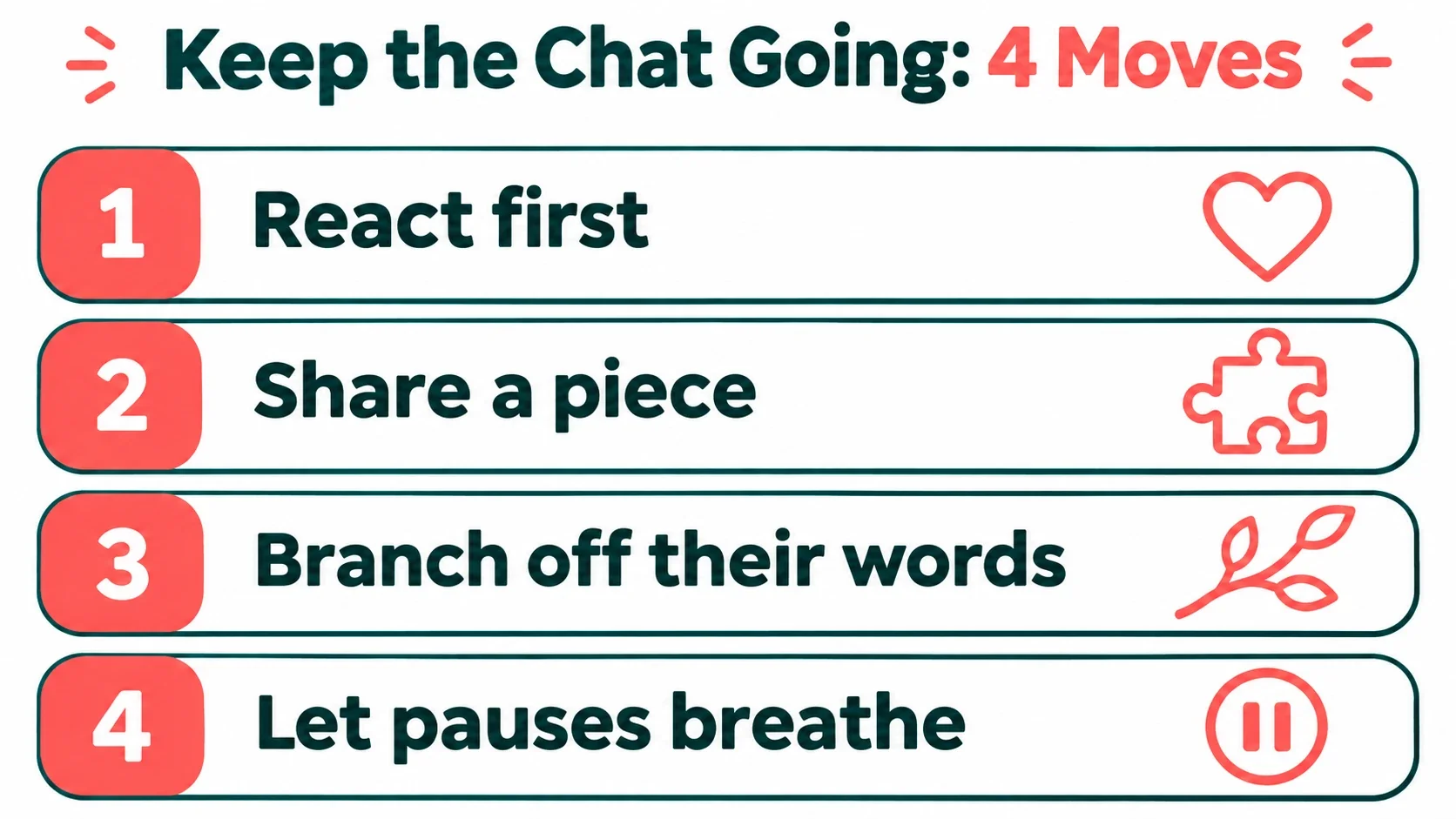
The cheapest move that exists: say something about their answer before you ask the next question. They mention they just moved. Instead of "Where from?", try "Moving in November is brutal. Did you pick the new place or was it decided for you?" One reaction, one follow-up. The reaction proves you are listening, and people relax around listeners. It also gives them a second thread to pull: the month, the place, or the reason.
Add a piece of yourself
Reciprocity runs conversations. If they share, you share, and you do not need to overshare: a piece is enough. They ask what you do. "I'm a student" is a dead end. "I'm a student, which right now means I live on instant noodles and deadlines" gives them three directions: the field, the noodles, or the deadlines. Every answer you give should contain a hook.
The same rule applies at the very start. Once you have good conversation starters, upgrade them the same way: include something of yourself, because it gives the other person an obvious way in. And if the opening is where you struggle, the guide to starting a conversation with a stranger covers that first step in detail; what follows here is everything after the first exchange.
Branch off their words
This is the technique that quietly separates good chat partners from average ones. When their answer contains five words, do not switch topics. Pick the one word you are most curious about and grow it.
They say: "I spent the weekend at my sister's wedding." The switch move is "Cool. What music do you like?" That resets the conversation to zero. The branch move is "Sister's wedding! Were you the one giving a speech or the one hiding from the photographer?" It builds on what already exists, and depth is what makes a chat feel worth continuing. When you branch, the other person does not have to start over, so they keep investing.
Ask questions with a floor, not a ceiling
A yes/no question has a ceiling: one word ends it. "Do you like music?" is a ceiling. "What song have you had on repeat this week?" is a floor: the answer can go anywhere. Build most of your questions on floors, but do not stack them. One question at a time. Two questions in a row is an interrogation; three is a job interview.
Let pauses live
In text chat, a slow reply usually means a kettle, a bus, or a boss, not a verdict. Resist the urge to fill silence with "you there???" If the pause lasts long, come back with a branch, not with pressure: "Wait, going back to the wedding photographer story. How many photos survived?" Calm about pauses reads as confidence, and confidence is contagious in a chat.
Know when to let go
Some chats are not meant to be saved. If you are the only one asking, if three exchanges in a row come back as one word with no question, you are allowed to stop performing. Ending well is a skill of equal rank, and ending a conversation politely protects the whole experience: a good exit leaves both people willing to open the next random chat. Skipping is not a failure of the conversation. It is what keeps random chat low-stakes and worth coming back to.
FAQ
How long should I try before giving up on a chat?
There is no counter, but there are signals. If they ask you things back and their answers grow, keep going. If two or three exchanges in a row are one word with zero curiosity, the chat has told you what it is. Spend your energy on the next one.
What if I genuinely run out of topics?
Go back, not forward. Scroll up mentally: an earlier thread you dropped is usually waiting there. "You mentioned the deadline disaster earlier. Did it end in disaster?" Returning to an earlier topic is a compliment: it shows the chat was worth remembering.
Does this work the same in voice chat?
The core is the same: react, share, branch. In voice you have less editing time, so reactions matter even more, and pauses are more natural. A relaxed "huh, interesting" buys you a full second of thinking time and sounds engaged.
Is it rude to end a chat that is not working?
Random chat is built for low-stakes exits, and the exit button works both ways. A polite goodbye is kinder than slowly fading out, and it costs you one line.
Try it on the next chat
Keeping a conversation going is not a talent. It is four moves: react, share a piece of yourself, branch off their words, and let pauses breathe. Pick one, use it tonight, and add the rest as they start feeling natural.


