

Ghosting in an anonymous chat is when your conversation partner vanishes mid-dialogue without a goodbye. In random chats this happens constantly, and here is the honest truth: it is almost never personal. There are no profiles, no shared history and zero cost to leaving, so the usual social brakes simply don't apply. Understanding why it happens makes it sting less, and the format itself gives you the fastest recovery of any social space: one tap, new person.
What ghosting looks like in a random chat
In dating apps, ghosting means days of silence from someone you were building something with. In an anonymous chat, the scale is smaller: you are ten minutes into a good conversation, you send a message, and nothing comes back. The chat is technically alive, the person is just gone.
It still counts. That little drop in your stomach is real, even when the person who left has no name. But the context matters: in a random chat, leaving is a built-in feature of the format, not a verdict about you.
Why people ghost in anonymous chats
-
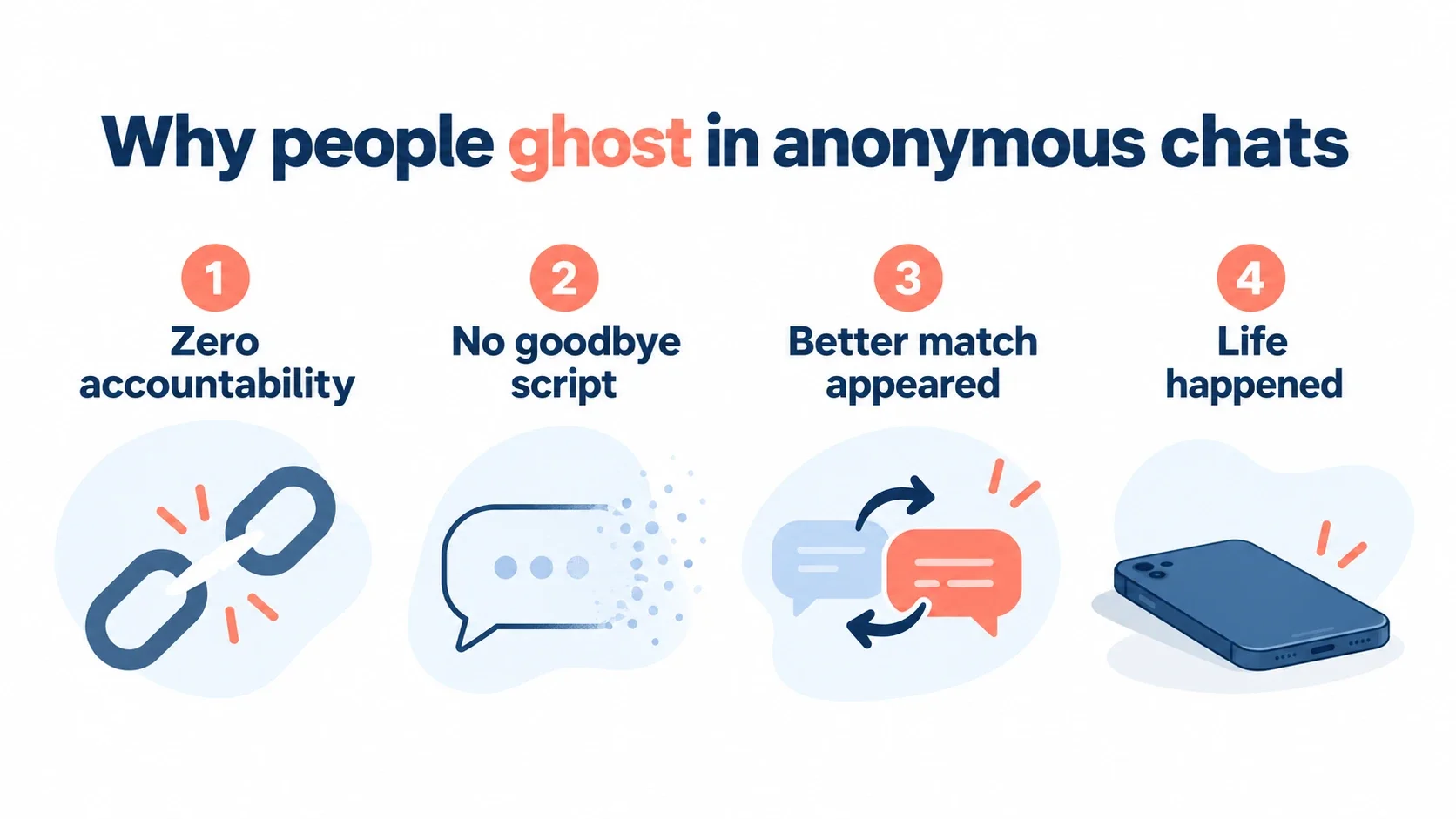
Zero accountability. They will never see you again, and nobody in their life will know. For many people, that removes the ordinary motivation to write a polite goodbye.
-
No closure script. A stranger's chat has no established etiquette for endings, so many users take the exit without looking for the right words.
-
A better match appeared. Some people treat random chats like channel surfing: the moment a conversation stops sparkling, they quietly move to the next search. It is impolite, but it is about their evening, not your worth.
-
Life happened. A call, a doorbell, a bus to catch. In anonymous chats you get no "brb", just silence, because the person assumes a stranger will not mind.
What ghosting says about you: nothing
This is the part worth internalizing. A person who left after ten minutes knows exactly one thing about you: one side of one conversation. They didn't see your face, your life, or your circle. Whatever reason they had, it was formed on almost no data.
Compare that with ghosting in dating or friendships, where silence comes loaded with history. In an anonymous chat, being left is closer to a slot machine not paying out than to rejection: random matching guarantees that some conversations will end abruptly, and guarantees nothing about what that ending means.
The one honest asymmetry
Here is a subtlety people rarely mention: the person who ghosted you may have enjoyed the conversation. People don't only leave bad chats; they also leave good ones, because the format makes staying optional. So a vanishing partner is not proof the talk was bad, and a long talk is not a promise of anything more.
There is also a mirror side. If you have ever closed a chat without a goodbye yourself, and most of us have, you know the decision took two seconds and carried no message. Extending the same understanding to others makes the whole format more pleasant.
How to move on in thirty seconds
Anonymous chats give you the shortest recovery loop in online communication:
-
Accept the format. Silence from a stranger is a normal outcome, not an emergency.
-
Don't replay the conversation looking for your mistake. On a sample of ten minutes, there is nothing to analyze.
-
Start a new search. By Chatus's own figures, a new match takes under a second, so the fastest cure for a dead chat is literally one tap away.
-
Give the next person a clean slate. The new stranger didn't ghost you; don't make them pay for the previous one.
You cannot chase the person who left, and that is a feature: Chatus has no profiles and no people search, so every new search is a fresh random roll. The door the ghost closed stays closed, but the hallway is full of other doors.
If you are the one who wants to disappear
Nobody can force you to write a farewell speech in an anonymous chat, and the chat etiquette guide will survive you leaving. But if the conversation was genuinely good, one short line ("hey, gotta run, this was fun") costs two seconds and leaves both sides better off. If you want to understand why random chats end so quickly in general, we broke down how long people actually talk to strangers online in a separate article: the short answer will not surprise you, but the pattern might.
And if your frustration with ghosting mostly comes from dating-app fatigue, where silences carry weeks of invested time, the no-profile, no-history format of anonymous chats is precisely what makes endings lighter. We wrote about how Chatus flips that script in dating without swiping.
FAQ
Is ghosting rude in an anonymous chat?
The norms are softer than in dating. Leaving a random chat without a goodbye is common enough that most users don't register it as an insult. Still, a short goodbye is a kindness, especially after a good talk.
Why does being ghosted hurt even from a stranger?
A fast-paced conversation creates a quick sense of connection, and an abrupt ending violates it. Psychologists describe this as a violation of social expectation rather than real loss, which is why the sting fades so quickly.
Can I find the same person again?
-
Chatus has no profiles or people search, and matching is random. The person who disappeared is genuinely gone, which sounds harsh but is also what makes every next conversation a clean start.
Should I say goodbye instead of ghosting?
If you can, yes. One line, no explanations needed. You will forget the chat either way; the stranger on the other side gets to close it properly.
Start your next conversation
Someone disappeared? Their loss, briefly and anonymously. Open Chatus and roll again: the next stranger is one tap away, and they might be the best conversation of your week.